
Konpirasha Enseiji Temple
円政寺
Culture · Hagi · Yamaguchi · Japan

About this place
The Ōuchi were ousted from their position in western Honshū by the Mōri family, who made Enseiji their primary place of worship.
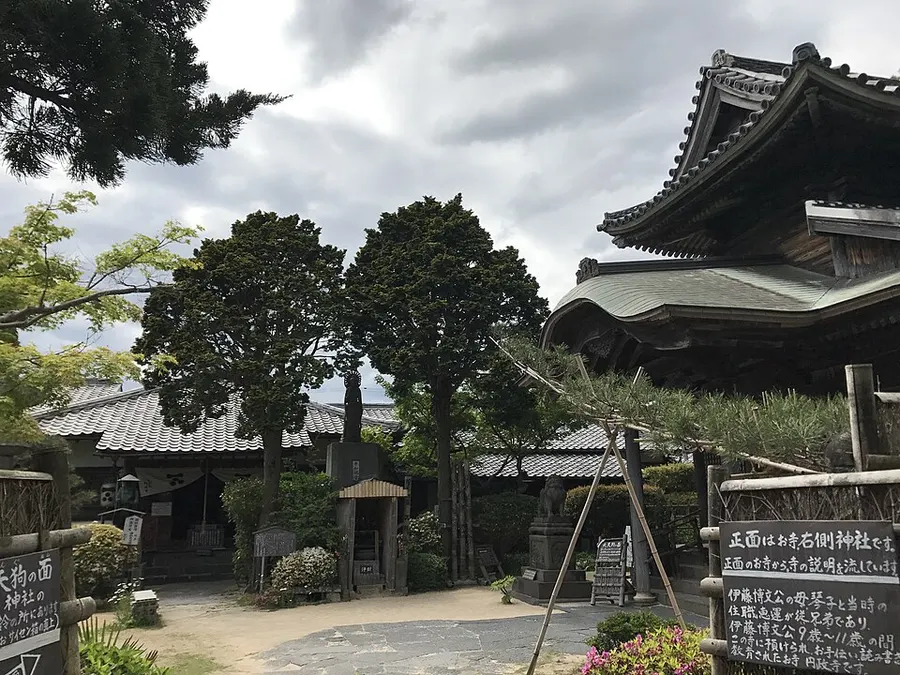
Enseiji Temple was founded in 1254 in Yamaguchi as the main place of worship for the Ōuchi clan, a family that was powerful during the Warring States period (1467–1568). The Ōuchi were ousted from their position in western Honshū by the Mōri family, who made Enseiji their primary place of worship. In 1604, when the Mōri moved their capital to Hagi, they had the temple relocated to a site near Hagi Castle. During the mid-nineteenth century, the temple was recorded in a guidebook to famous places in Hagi, the Yae hagi meisho zue, which noted its prominence among the region’s places of worship.
Enseiji is affiliated with Shingon Buddhism, but it also has a Shinto deity enshrined within its precincts. Konpira is the guardian deity of seafarers, navigation, and fishermen. Although rare today, the practice of shared sacred space was not uncommon prior to the Meiji era (1868–1912). The torii gate at the front of the temple is another indication of how tightly the two religions were entwined.
The outer eaves of the Konpira shrine hall are decorated with carvings of the 12 animals of the Chinese zodiac. Above the entrance is a massive tengu (red-faced goblin) mask. Created in 1838, it is connected to a local story about Takasugi Shinsaku (1839–1867). As a young child, Shinsaku is said to have been brought to stand before its fearsome visage to learn to overcome his fear. Shinsaku grew up to be one of the samurai leaders who worked to overthrow the Tokugawa shogunate in the 1860s. He was implicated in the December 12, 1862 attack on the British legation in Edo, and the following year he recruited commoners and samurai into a new, mixed unit called the Kiheitai. He died from tuberculosis at age 28—a year before the fall of the shogunate in 1868.
This English-language text was created by the Japan Tourism Agency.