
Gokōnomiya Shrine
御香宮神社
Culture · Fushimi-ku, Kyoto · Kyoto · Japan

About this place
A spring gave this Fushimi shrine its name, which means fragrant water. Local people helped restore the spring after it ran dry, and the area’s sake brewers have long prayed here.
It is unclear exactly when Gokōnomiya Shrine was built, but its repair is mentioned in records from the Heian period (794–1185). Originally, it was known as Mimoro Shrine, but on September 9, 863, an event occurred that was to change its destiny: pure, cold spring water began to flow up out of the ground. When Emperor Seiwa (850–881) heard of this miraculous event, he ordered the shrine’s name changed to Gokōnomiya, meaning the “Shrine of Fragrant Water.” The spring dried up during the Meiji era (1868–1912) but was restored through local contributions in the early 1980s and in 1985 was chosen as one of “Japan’s 100 Remarkable Waters” by the Ministry of the Environment.
During the 1590s, when warlord Toyotomi Hideyoshi (1537–1598) built Fushimi Castle, he ordered the shrine moved to the northeast corner of the castle. In Japanese geomancy, northeast is known as the kimon, or demon gate, and shrines were often built in the northeast to fend off malevolent forces from that unlucky direction. In 1605, the shogun Tokugawa Ieyasu (1543–1616) had it moved back to its original and current position.
What to look for
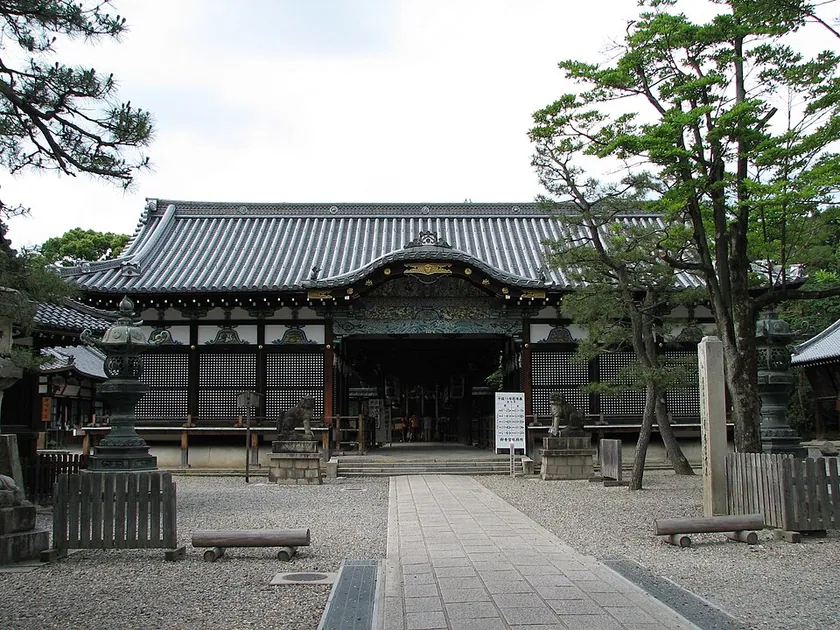
The outer gate came from Fushimi Castle. Past it, look for turquoise water patterns on the brightly painted shrine building.
East of the main torii, bullet marks on the smaller Tenmangu shrine recall the 1868 Battle of Toba-Fushimi.
Plan your visit
- Opening hours
- The stone garden receives visitors 9am–3:30pm. The shrine office issues amulets and goshuin stamps 9am–4pm.
- Admission
- The rock garden has a separate admission of ¥200 for adults and ¥100 for students. Ceremonies can affect garden access.
- Getting there
- It is about five minutes on foot from Keihan Fushimi-Momoyama, Kintetsu Momoyama-goryomae or JR Momoyama station.
Visitor sources
Visitor information checked