
Heian Jingu Shrine
平安神宮
Culture · Sakyo-ku, Kyoto · Kyoto · Japan

About this place
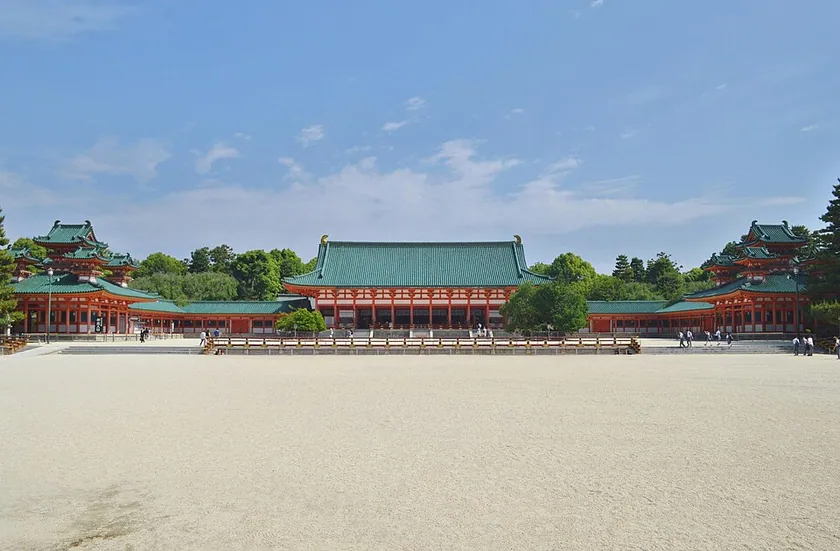
The red halls around Heian Jingu’s gravel court recreate the setting where Kyoto’s early emperors conducted affairs of state. Kyoto built this smaller version in 1895 to mark 1,100 years since the capital’s founding.
Heian Jingu Shrine celebrates the legacy of the ancient capital of Kyoto with ornate architecture and beautiful gardens open to the public. The shrine is a 5:8 scale replica of one of the innermost parts of Heiankyo, the imperial capital of Japan for more than one thousand years.
Discover Heiankyo and the rich cultural heritage of Kyoto while exploring Heian Jingu and its landscape gardens.
Heian Jingu was built in 1895 to coincide with celebrations marking the 1,100th anniversary of the founding of Heiankyo, the imperial capital of Japan from the late eighth to mid-nineteenth centuries. It enshrines Emperor Kanmu (737–806), the first emperor of the Heian period (794–1185), and Emperor Komei (1831–1866), the last emperor to rule from Heiankyo.
The shrine is atypical in that it is modeled on a part of the ancient capital known as the State Hall of the Imperial Palace, or Chodoin complex, that was the administrative part of the city and the place where the emperor presided over state affairs. The shrine’s ornate halls and buildings are arranged symmetrically around a spacious, graveled courtyard. Several of these, including the Daigokuden (outer hall of worship) and the Otenmon Gate (main gate), are designated Important Cultural Properties of Japan. The bright vermilion buildings stand out against the white gravel of the courtyard and the lush, surrounding greenery.
What to look for
Stand on the courtyard’s central axis and compare the matching buildings to either side. The symmetry follows the ancient palace plan.
A separate entrance inside the courtyard leads into four landscape gardens. Leave about 40 minutes if you want to explore them as well.
Plan your visit
- Opening hours
- Shrine gates open at 6am and the garden at 8:30am. Last garden entry is 5:30pm March–September, 5pm in October and 4:30pm November–February. The grounds close half an hour later. Festivals can change the hours.
- Admission
- Worship in the shrine precincts is free. The Shin’en garden costs ¥600 for adults or ¥300 for elementary and junior high school students. Preschool children enter free.
- Getting there
- Walk about ten minutes from Higashiyama Station on the Tozai subway line, or about fifteen from Keihan Jingu-Marutamachi.
Visitor sources
Visitor information checked