
Higashi Honganji Temple
東本願寺
Culture · Shimogyo-ku, Kyoto · Kyoto · Japan

About this place
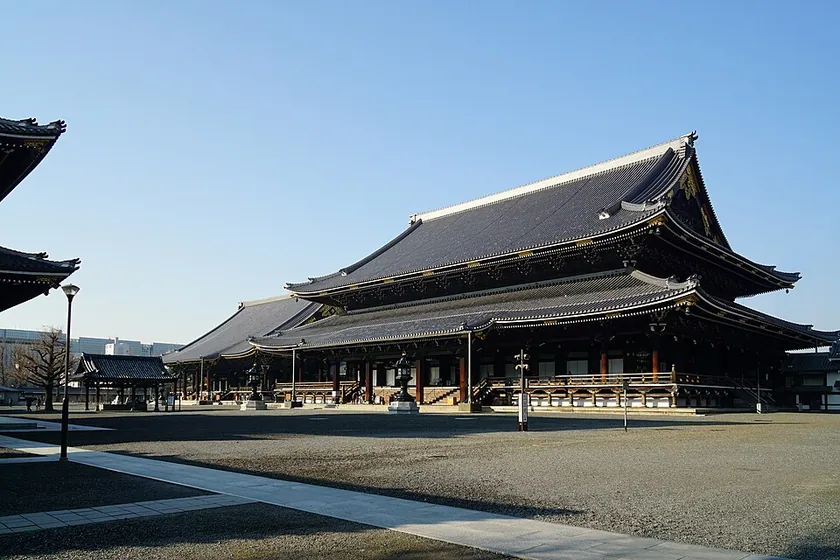
Two enormous timber halls stand side by side here. The larger hall honors Shinran, founder of the Jodo Shinshu Buddhist tradition, while its neighbor enshrines Amida Buddha. Both rose in 1895 after fire destroyed their predecessors.
Higashi Honganji is the head temple of the Otani branch of Jodo Shinshu (True Pure Land), one of the largest Buddhist denominations in Japan. The temple’s official name is Shinshu Honbyo (“main Shinshu mausoleum”), which refers to its origins as the tomb of Shinran (1173–1262), the founder of Jodo Shinshu.
Shinran’s original mausoleum was located in Otani, in what is now the eastern part of the city of Kyoto. His great-grandson Kakunyo (1270–1351) converted the burial complex into a place of worship. Named Honganji, the temple flourished under its eighth head priest, Rennyo (1415–1499), who considerably expanded its membership and influence. However, Rennyo’s early success was deemed a threat by the Tendai school, which until then was the Buddhist movement with the greatest influence in the court. As a result, Tendai monks destroyed Honganji and drove Rennyo out of the city, but that became an opportunity for him to further spread Jodo Shinshu teachings outside Kyoto.
Honganji was later reestablished elsewhere in Kyoto and then in Osaka, but was burned down by rivals for influence on both occasions. Jodo Shinshu endured nonetheless, and in the late sixteenth century, the school rebuilt its head temple in Kyoto under the protection of Toyotomi Hideyoshi (1537–1598), the warlord and regent who was the most powerful man in the country at the time.
What to look for
Notice that the founder’s hall has its own monumental entrance gate. The gate was completed in 1911, after both worship halls.
The name Higashi means east. A succession dispute divided the earlier Honganji institution, and its two branches still have separate head temples in Kyoto.
Plan your visit
- Opening hours
- 5:50am–5:30pm March–October. The winter schedule is 6:20am–4:30pm November–February.
- Admission
- General visits to the temple are free during opening hours.
- Getting there
- Walk north on Karasuma-dori from Kyoto Station, about seven minutes. Gojo subway station is a five-minute walk from the other direction.
Visitor sources
Visitor information checked