
Jurinji Temple
十輪寺
Culture · Nishikyo-ku, Kyoto · Kyoto · Japan

About this place
Jurinji remembers the poet Ariwara no Narihira, who according to local tradition spent his last years here. His world of court musicians, nobles and love stories reappears across the temple’s painted screens.
Jurinji Temple in the foothills of the Nishiyama mountain range along Kyoto’s western border is known as a place to pray for conception and safe childbirth. It once served as the retirement temple of Ariwara no Narihira (825–880), a prominent ninth-century poet. In addition to its famous early blooming cherry tree, other attractions in the quiet, secluded temple include two gardens, painted sliding panels in one of the halls depicting scenes from Ise monogatari (The Tales of Ise), a small memorial pagoda dedicated to Narihira, and a traditional salt kiln.
The temple was founded in 850 by Emperor Montoku (827–858), who enshrined a wooden statue of Enmei Jizo Bodhisattva (“Jizo of long life”) to pray for the safe birth of his child with his consort Fujiwara no Akirakeiko (829–900). The emperor’s prayers were answered, and their son later ascended the throne. The Jizo statue is said to have been carved by Saicho (Dengyo Daishi, 767–822), the founder of Tendai Buddhism in Japan.
Jurinji burned down during the Onin War (1467–1477), a conflict over shogunate succession that damaged most of Kyoto. The temple lay in ruins until the Kanbun era (1661–1673), when it was rebuilt by the noble Kasanoin family. Jurinji became their family memorial temple (bodaiji), tasked with holding burial rituals, caring for family graves, and praying for their souls after death.
What to look for
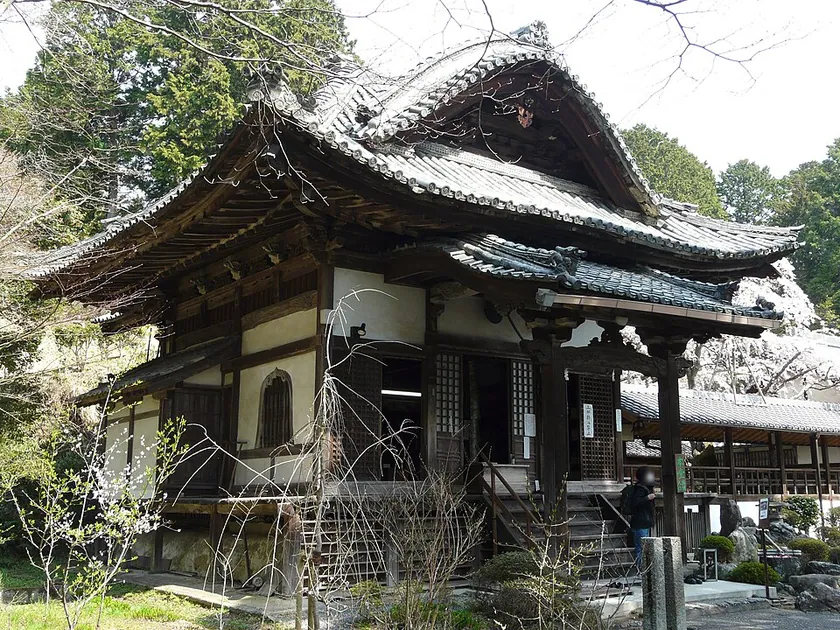
Look up at the main hall’s curved roof. Its shape recalls a palanquin, the covered litter in which an aristocrat once traveled.
The temple’s early-flowering cherry and painted scenes from The Tales of Ise offer two ways to explore its associations with Narihira.
Plan your visit
- Opening hours
- 9 am–5 pm.
- Admission
- ¥500.
- Getting there
- Take a Hankyu bus to Haigata, then walk about 25–30 minutes. The temple is in Oharano Oshiocho in western Kyoto.
Visitor sources
Visitor information checked