
Shoryuji Temple
勝龍寺
Culture · Nagaokakyo · Kyoto · Japan

About this place
According to temple legend, the monk Kukai (Kobo Daishi, 774–835), the founder of the Shingon school of Buddhism, established Shoryuji in 806.
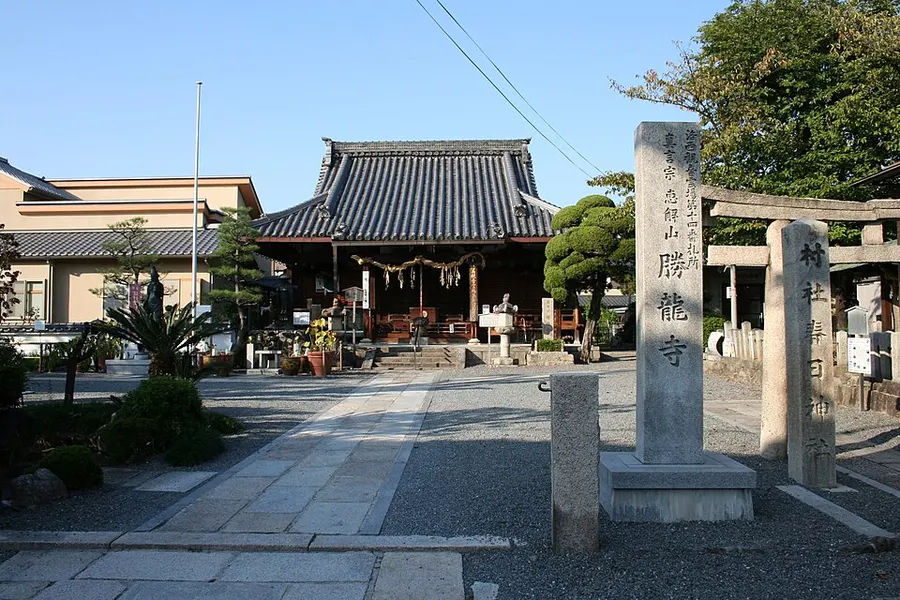
According to temple legend, the monk Kukai (Kobo Daishi, 774–835), the founder of the Shingon school of Buddhism, established Shoryuji in 806. He named it after a temple in China where he had studied, with kanji characters for “blue dragon.” It is said that during a severe drought in 962, the emperor ordered the chief abbot Senkan (918–984) to spend a week praying for rain. After the long-awaited rain fell, the characters for the temple name were changed to mean “victory over the dragon,” reflecting how the power of prayer overcame the will of the divine creature ruling over water.
Hanging over the Hondo entryway is a sacred rope shaped like an undulating dragon flying west toward the Nishiyama mountains. At the beginning of each year, community members make a new sacred rope by hand. Historically, the quality of the resulting rope was used to predict how bountiful the year’s harvest would be. The principal object of worship at Shoryuji is a statue of the Eleven-Headed Kannon, the bodhisattva of compassion. It dates to the Kamakura period (1185–1333) and is a nationally designated Important Cultural Property kept at the Kyoto National Museum outside of special ritual periods. Please note that the Hondo is generally closed to the public.
This English-language text was created by the Japan Tourism Agency.