
Kikuchi Castle
鞠智城
Culture · Yamaga · Kumamoto · Japan

About this place
Towers, storehouses, and other buildings have been reconstructed on the former site of Kikuchi Castle, a mountaintop fortress dating to the seventh century.
Towers, storehouses, and other buildings have been reconstructed on the former site of Kikuchi Castle, a mountaintop fortress dating to the seventh century. The remains of 72 structures were discovered here through successive archaeological excavations, and these relics have provided the basis for the reconstructions. The vast site covers 55 hectares and is preserved as a park with beautiful natural scenery and walking paths.
The original fortress was built in the seventh century during a time of tension and conflict between the Yamato state, based in Nara, and Silla, a kingdom part of present-day Korea, allied with Tang China. In that era, Dazaifu (in present-day Fukuoka Prefecture), 60 kilometers from the castle, was a major regional seat of power. Kikuchi was one of four castles built in northern Kyushu to protect Dazaifu. As the southernmost fortress, and therefore the farthest from a possible enemy attack, Kikuchi Castle played a supportive role to ensure the other castles had adequate food, weaponry, and fighters.
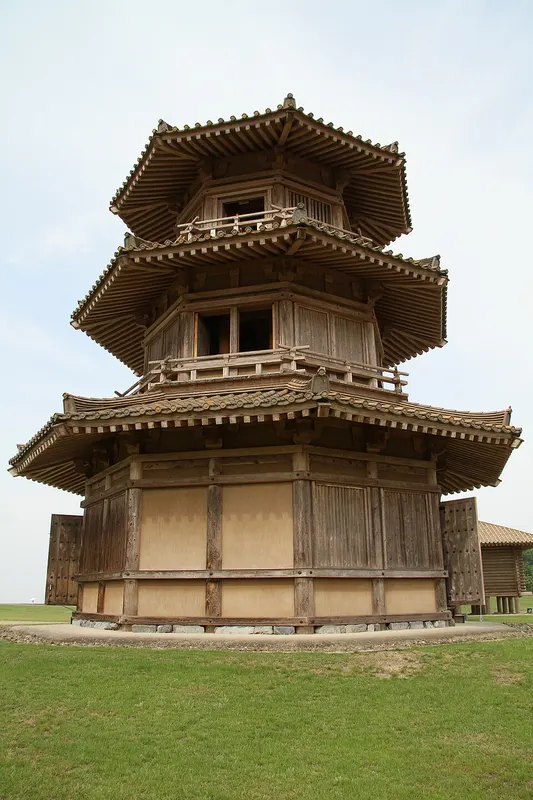
Today, the largest and most striking structure of the castle park is the Octagonal Drum Tower. It is believed to have served as a watchtower and a kind of belfry where drums were beaten at regular intervals to indicate the time. The tower measures 15.8 meters in height and has a tile roof weighing 76 tons. The nearby rice storehouse elevated on stilts is an example of the azekura-zukuri style of building, constructed of wooden members that are triangular in cross-section. This method of construction helps regulate the humidity of the storehouse’s interior. Also nearby is the Itakura, an armory with a thatched roof. Each of these structures offers an insight into the architecture and aesthetics of the Asuka period (592–710). Visitors may tour the exterior of each structure but are not allowed to enter.
This English-language text was created by the Japan Tourism Agency.